
Unfinished Business
I need your help

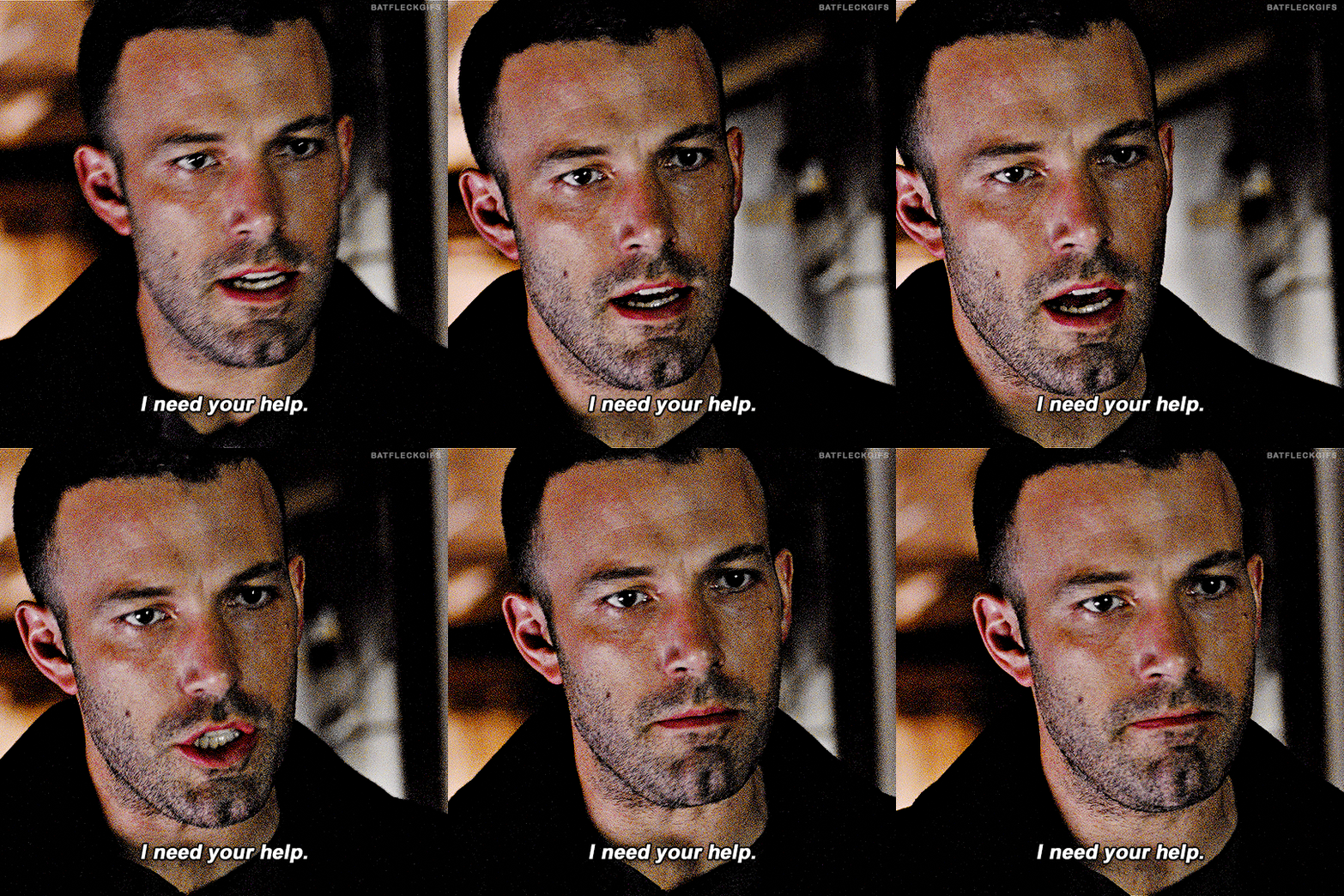
I need your help.
It’s a line that’s used a lot in dramatic features and series, usually when characters hit a wall or realize that an obstacle is too big for them to tackle alone. Once you hear it, you can’t unhear it. It sticks out like a ‘90s sitcom laugh track or a mic bump accidentally left in the mix.
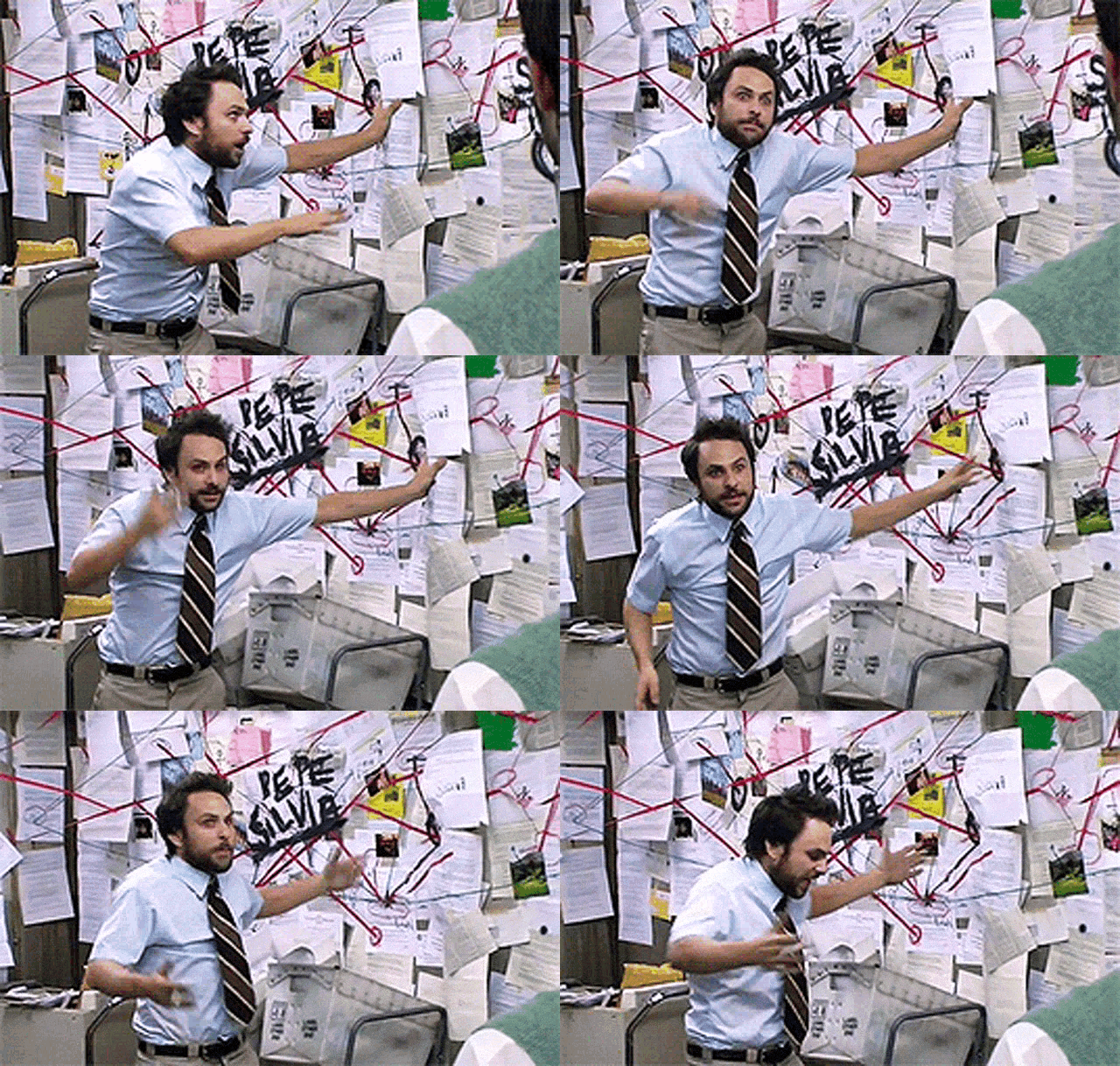
Over the years, I’ve come to realize that this specific line of dialogue is so overused it’s practically a genre convention. It’s comparable to that moment in a psychological thriller or true-crime procedural when someone flips over a corkboard, revealing photos and newspaper clippings connected by red string. The trope even has its own nicknames: Red String Theory.
If you’ve never noticed before, I’m sorry to be the one who ruins I need your help for you. Desperate times, after all, require us to sacrifice the things we love.
Before I knew it was a cliché, I used the line myself. I loved it so much I put it in one of the very first scripts I ever wrote. This was for a sizzle trailer for a feature-length narrative film I wanted to write and direct with my longtime collaborator, Steve J. Adams. The story was inspired by a newspaper article I read in 2006 about a young man who showed up at a church on a rainy winter night with no memory of who he was or how he got there.
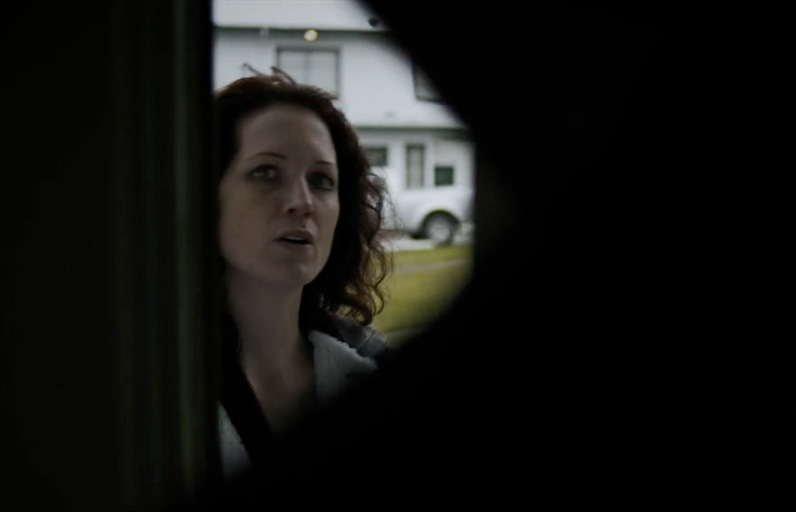
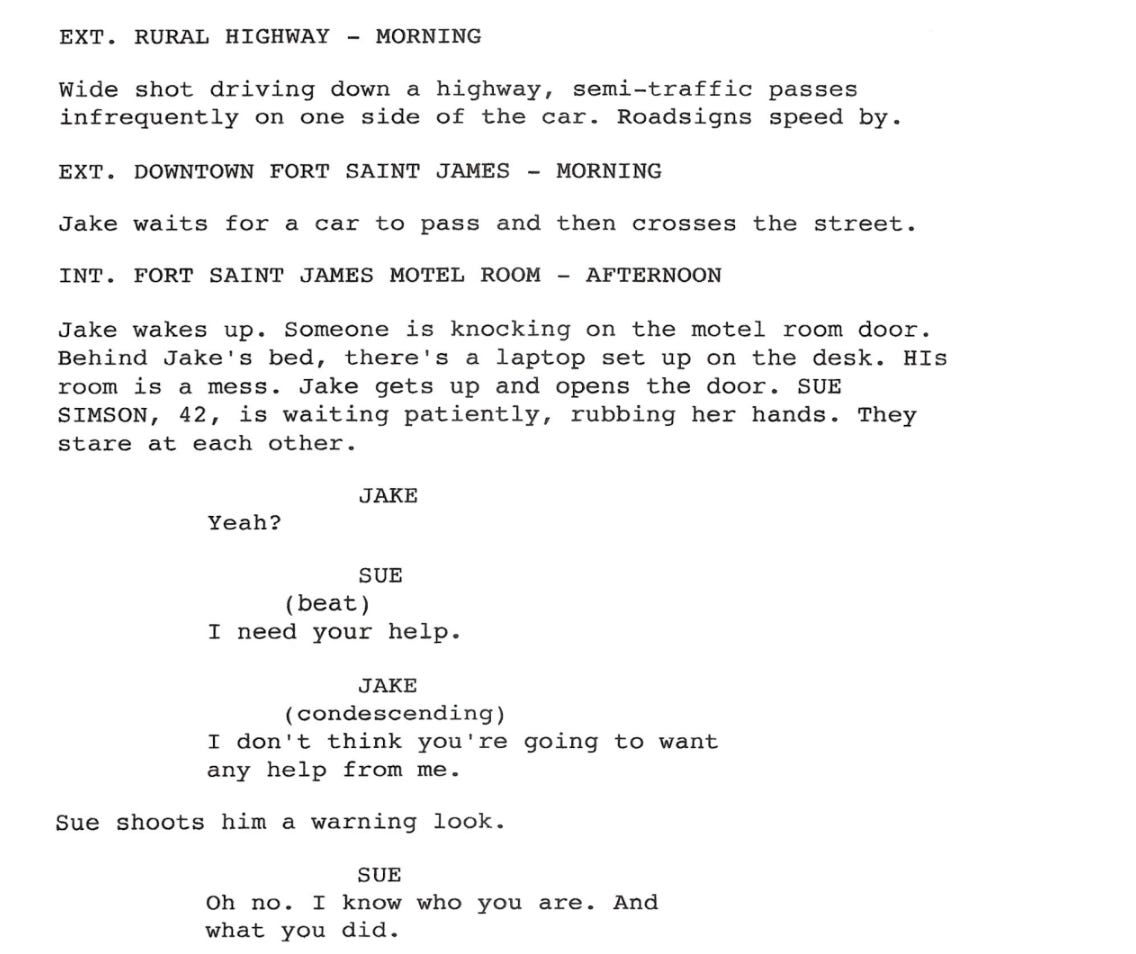
Reading this now makes me cringe, but I remember being on set when we were rolling, and I called action. When Andrea, the actor playing Sue, delivered her line, I had a full-body reaction. I could feel the hair on my forearms stand up. It was a feeling of being exactly where I was supposed to be.
The film’s working title was The Mill and the Mountain. In 2013, Steve and I submitted it—along with our cinematographer, Sean Cox—to CineCoup, a film accelerator run like a social media competition. Teams pitched their films to an online audience. The winner would receive financing to make a full feature. After months of videos, posts, and promotion, I sat down and wrote a full script so we could qualify for the final round. We made it to the top ten. Then we got the chop.
I was devastated. Despite having no formal education in film and almost no experience writing or directing narrative, I was convinced this film would be my big break—an optimism I now recognize as both touching and deeply delusional, and possibly a prerequisite for a career in film.
Still, a couple of months later, we convinced a producer and a more experienced screenwriter to come on board. By 2014, the project stalled in rewrites and quietly died. We continued to squeak by on commercial work until someone who’d followed our CineCoup campaign offered us the chance to direct a six-part online documentary series.
Looking back, this is how my career has always seemed to work. I aim for one thing, miss, and end up somewhere else entirely. Ten years later, I’m a documentary filmmaker with a slate of projects on the go and a newfound nonfiction writing itch for which there is no cure.
Which is to say: I’ve gotten very good at knocking on doors.
Right now, I’m Sue Simson, standing outside your room at the Fort Saint James Motel. It’s minus twenty degrees. The sun is setting. I’m not wearing a proper winter coat, which in this country, at this time of year, means I’m counting on you to open up and let me in.
This time last year, I escaped to Brazil in hopes of avoiding yet another season of self-recrimination and emotional bookkeeping. It worked, sort of. While I was there, I made a handful of New Year’s resolutions while jumping over seven waves at Praia do Porto das Dunas, outside Fortaleza, on the north coast of Ceará. My boyfriend told me it was a Brazilian tradition, that it would be bad luck not to do it at the first beach we visited after meeting with his parents.
One of the resolutions I made was to try writing on Substack again, for the third and final time. I promised myself I’d take it seriously. That if I stopped again, I’d stop for good.
When I first started writing here in 2022, I thought I knew exactly what I wanted to do. I wanted to tell a serial story: one long investigation into a woman from my childhood whose presence I believed had quietly destabilized my family, and whose reappearance in my life a decade later made me want to revisit a version of the past I’ve never fully understood.
But in trying to tell that story, I collided with another one: a car accident I survived and never investigated, a first love that never had room to exist, followed immediately by the loss of my mother. I buried those things to move on. I refused to talk about them, even with the people closest to me. Now, years later, I have questions.
Trying to explore these two serial stories at once was too much, too soon. I stopped writing and let my film work consume me instead.
I tried Substack a second time a year later, writing essays in advance of the SXSW premiere of my second feature, Satan Wants You, a documentary about the Satanic Panic and all the strange ways memory and belief can fail us. But when my personal life fell apart after the film premiered, I gave up, and Substack became a place I associated with failure, sadness, unfinished things.
This past year, I came back a third time. I wrote twelve essays. Patterns started to emerge in the writing, but each piece felt like I was starting over from scratch, instead of building towards something bigger. What writing consistently this year taught me is simple: I don’t want to keep starting over. I want to tell one story, properly, from beginning to end. A serial. To do the thing I set out to do here in the first place.
And this is where you come in. I can’t do all of these stories at once. And I don’t want to pretend I can. So I’m asking you to help me choose which of these unfinished stories I finally commit to telling here over the next year:
Option 1: A Body of Work
Central idea: What happens when your body becomes your résumé?
I’ve been offered an opportunity to go back in front of the camera later this year. The last time I said yes to something like this was in 2009. My friend Rob and I had sold Don’t Quit Your Gay Job to a network on our first try and my life changed overnight. I went from an unemployed, struggling writer to the creator and host of a reality TV series. On camera, the show rewarded me for being all surface, no substance. I became a body, an object, that shirtless guy on TV. But off camera, competing for wins and screen time twisted me into someone I didn’t recognize, eventually costing me my friendship with Rob and the show itself. Years later, watching a new generation of men build entire careers out of being visible online, I’m curious about the performance of masculinity, about what visibility means now that it has exploded and fragmented through social media, and what chasing this kind of attention might cost me now.
Central idea: What happens when avoidance becomes survival?
In January 2001, shortly before my twentieth birthday, I had fallen in love with a man for the first time and was in the process of coming out. A week later, I was hit by a pickup truck while walking along a highway on Vancouver Island. When I woke up in the hospital, I had no memory of what had happened. Six months later, my mother died. This series would apply the tools I’ve learned as an investigative filmmaker to fill in the blanks: court records, eyewitnesses, the driver, the people who loved me then—and to ask the questions I’ve avoided for over twenty years about why this moment still won’t let me go.
Option 3: The Other Woman
Central idea: What happens when you inherit a story that isn’t yours?
A serial investigation into the first queer person I ever knew and the story I built around her as a child. It begins in the late 1980s on Vancouver Island, where my mother’s close friendship with a female neighbour coincided with my parents’ near-separation. Years after my mother’s death, that woman emailed me with the subject line Ghost From The Past, which was the inciting incident for this Substack. This series would follow my attempt to separate memory from myth: interviewing my family, retracing the places I grew up, and finally meeting her to ask the questions I never could as a kid.
Help me choose what comes next:
I’ll commit to the winning choice as a serialized project in 2026.
Thanks for spending time with me here. Happy New Year!
For the record I love all of the possible topics/investigations 🕵️
I want it all, Sean. Memoire and biography and my fav genres and any and all of these options have my vote ❤️